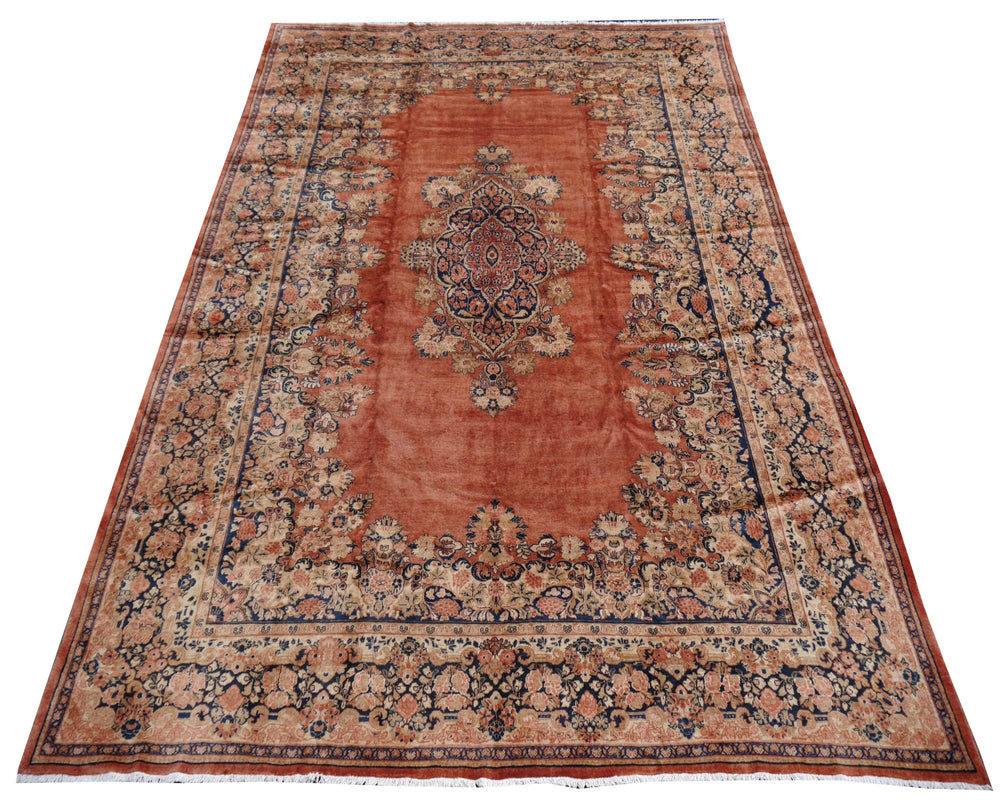
Palatial Mahal Semi-Antique Sarouk 12 × 18 ft (380 × 540 cm) Rust Navy | 15053
15053
- Fast shipping by UPS, FEDEX or DHL
- Low stock - 1 item left

Palatial Mahal Semi-Antique Sarouk
380 × 540 cm · Rust, Navy & Ivory
A finely drawn floral medallion floating on an open rust-red field, framed by a broad blossom border — a palatial Mahal Sarouk from one of the great decades of Persian weaving.
A Palatial Mahal Sarouk, circa 1950
This piece comes from the Mahal region around Arak in central Iran — one of the most renowned weaving centres of the country and home to the Mahal, Sultanabad and Sarouk weaving cluster. The mid-twentieth century marks a high point of Persian knotting craftsmanship, an era in which experienced master weavers committed floral medallions with botanical precision into hand-spun wool.
This semi-antique example, roughly 75 to 85 years old, shows the open-field Sarouk drawing at its most confident: a central diamond medallion with floral pendants suspended on a largely open ground, floral-filled corner spandrels, and a broad, multi-band blossom border. The patina of decades of light and use gives the wool a depth that no new production can replicate.
Colour and Composition
The palette is built on a warm rust-red open field — the dominant ground — with the central medallion and border accents drawn in deep navy and indigo. The floral work carries salmon, soft rose, ivory and muted green, the saturations softened by decades into a balanced, lived-in register. The largely open field is the hallmark of fine Sarouk drawing: the medallion is allowed to breathe, rather than competing with an all-over pattern.
Presence in the Room
At 380 × 540 cm (20.5 m²) this is a true palatial format — a rug woven for grand reception halls, ballrooms and stately lobbies. Three contexts in which the piece reaches its full effect:
- Grand reception room: Beneath a historic chandelier, with gilt furniture and brocade, the Mahal carries the full palatial weight.
- Modern open-plan loft: In a minimal interior, the semi-antique piece creates a striking dialogue between tradition and contemporary architecture.
- Luxury hospitality: Hotel foyers, boutique-hotel lobbies or representative conference rooms — the rust-and-navy palette signals quality and history from the first second.
Specifications
| Size | 380 × 540 cm (12 × 18 ft) · 20.5 m² |
| Origin | Mahal Sarouk (Arak region), Iran |
| Pile material | Hand-spun wool |
| Foundation | Cotton warp and weft |
| Technique | Hand-knotted, Persian knot |
| Design | Open-field floral medallion with pendants and corner spandrels |
| Colours | Rust-red, navy, ivory, salmon, muted green |
| Era | Semi-antique, c. 1950 (approx. 75–85 years) |
| Condition | Very good, full pile, age-appropriate patina |
| Underfloor heating | Suitable |
1stDibs Recognised Dealer
Djoharian carries the Recognised Dealer badge on 1stDibs since 2013, with a 5.0/5 verified rating — a standard of authentication and presentation that serious collectors and design professionals can rely on.
Responsible Origin · Label STEP
Djoharian is a certified partner of Label STEP, the international fair-trade organisation for hand-knotted rugs. STEP audits production conditions on the ground — wages, working environment, no child labour — and tracks pieces from loom to dealer.
Djoharian — Since 1967
Our family business was founded in 1967, with roots in the Grand Carpet Bazaar of Tehran. Five decades of trade and connoisseurship inform every piece we offer — collected, vetted, and presented with the documentation a serious collector expects.
Service
Secure and fast worldwide shipping, fully insured. Each piece is professionally packed and documented. We are available for any questions on placement, care, or comparable pieces.
Shipping Costs & Delivery Times
"Secure, worldwide insured transit for your masterpieces."
International Rates
-
Germany (1–4 Days) Over 100.00 EUR: Free ShippingCart 0.00–100.00 EUR: 7.95 EUR
-
Europe (Eurozone) (1–4 Days) Over 100.00 EUR: Free ShippingBelgium, Estonia, Ireland, Greece, Spain, France, Italy, Latvia, Lithuania, Luxembourg, Malta, Netherlands, Austria, Portugal, Slovenia, Slovakia, Finland, Cyprus, Croatia, Czech RepublicCart 0.00–100.00 EUR: 16.50 EUR
-
Denmark (1–4 Days) Over 1,500.00 KR: Free ShippingCart 0.00–1,500.00 KR: 120.00 KR
-
USA (1–4 Days) Over 100.00 USD: Free ShippingCart 0.00–100.00 USD: 15.00 USD
-
Canada (1–4 Days) Over 500.00 CAD: Free ShippingCart 0.00–500.00 CAD: 65.00 CAD
-
Saudi Arabia (4–8 Days) Over 2,200.00 SAR: Free ShippingCart 0.00–2,200.00 SAR: 250.00 SAR
-
Singapore (4–8 Days) Over 2,500.00 SGD: Free Shipping0.00–500.00 SGD: 85.00 SGD | 500.00–2,500.00 SGD: 150.00 SGD
-
South Africa (By Weight in EUR)Up to 10kg: 110.00 | 15kg: 125.00 | 20kg: 145.00 | 30kg: 185.00
40kg: 200.00 | 50kg: 225.00 | 60kg: 235.00 | 70kg: 285.00
We ship worldwide. For an individual shipping offer to countries not listed, please contact us.
Customs & Export Information
Purchases above EUR 1,000.00 must be declared to the German Customs office. Please allow two additional business days for processing the Export Declaration Form prior to shipment.
EU Customers: All items are shipped from our gallery in Bavaria, Germany. Sales to customers within the European Union include VAT; no customs duties apply.
Non-EU Customers: Sales to destinations outside the EU do not include German VAT or international customs duties. Any import taxes or duties charged by the destination country are the sole responsibility of the buyer. Customs clearance is handled by the shipping company; any applicable fees will be collected upon or before delivery.
Payment Options
We offer the following secure payment methods:
- Bank Transfer: Secure SEPA / EU Standard transfer (on request)
- Shopify Payments: Visa, Mastercard, AMEX, UnionPay, Klarna, Google/Apple Pay, iDEAL, EPS, Bancontact
- In-Store: Cash payment upon collection from our gallery
Returns & Exchanges
The buyer is responsible for return shipping costs. Please refer to our full policies:
To Right of Withdrawal