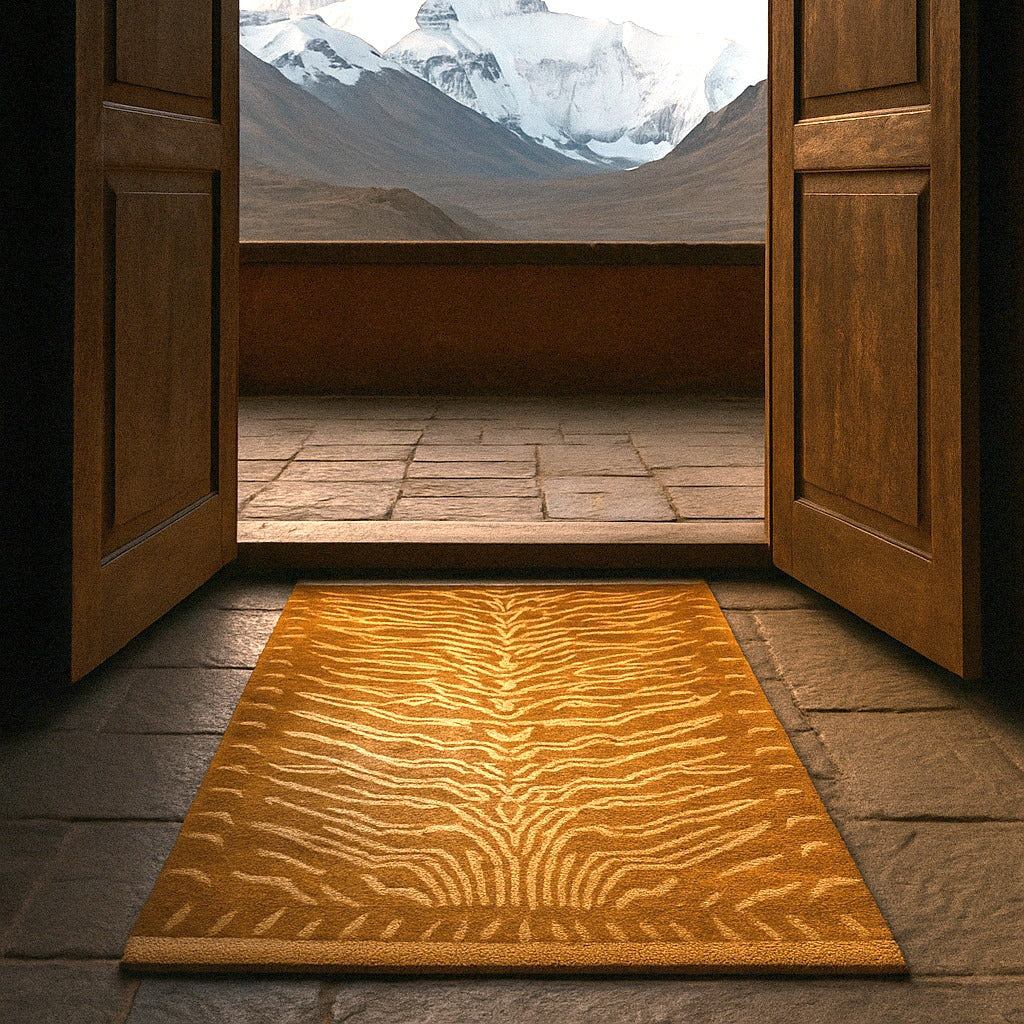
Djoharian Design · Tibetan Tiger
Tibetan Tiger Silk Rug
180 × 90 cm · Sand & Cashew · Khaden Format
Hand-knotted in Kathmandu from 66% Chinese Matka silk and 34% Changpai highland wool, in the traditional Khaden format.
Heritage and Knotting Tradition
The Tibetan tiger rug is one of the oldest motifs in Himalayan textile culture. For centuries, tiger rugs in this format were used in Tibetan monasteries and palaces as seats for high lamas during meditation, as covers for ceremonial columns, and as honour places for rulers and teachers. The tiger itself symbolises power, protective strength and spiritual vigilance — the embodiment of the awakened mind in Vajrayana Buddhism.
This piece is hand-knotted in the workshops of Kathmandu, Nepal, by experienced artisans in the Tibetan knotting tradition. The material composition is 66% Chinese Matka silk and 34% hand-spun Changpai highland wool. Changpai, from sheep raised above 4,000 metres on the Tibetan plateau, is exceptionally long-staple and lustrous; Matka silk is the hand-reeled silk from China prized for its slubby texture and natural lustre. The two yarns are blended into a single fibre at the spinning stage — both the tiger stripes and the ground are knotted from the same wool-silk blend, giving the rug a unified, calm surface where the silk lifts the tone rather than punctuating it. The pile height is approximately 11 mm.
Colour and Composition
The palette is built on Pantone 15-1225 TPG Sand and 17-1137 TPG Cashew — a contemporary, deliberately quiet pairing with natural abrash, the soft variation in colour that arises from hand-spun, naturally dyed yarn. Because the same wool-silk blend runs through both the tiger and the ground, the surface stays tonal and unified: the tiger reads at close range, but at distance the rug becomes a calm foundation. A composition built for rooms where the architecture and the art should remain in focus.
Presence in the Room
At 180 × 90 cm (1.6 m²) this is the classical Tibetan Khaden format. Three contexts in which this tonal Tibetan Tiger reaches its full effect:
-
Entrance or hallway in a quiet palette: the sand-and-cashew pairing is built for understated luxury — a piece that signals quality on the way in without ornament-overload.
-
Bedroom or dressing area: the soft tonal warmth and the silk-blend pile make this the natural choice for a bedroom where the textile should comfort rather than declare.
-
Wall hanging or art-textile placement: the Khaden format and the abrash-modulated surface make this an outstanding candidate for a textile-art context where the silk catches shifting daylight.
Bespoke — Made to Order
This design is part of our Djoharian Design made-to-order programme. Adaptable to your project:
-
Dimensions on request — any custom size
-
Colour palette matched to Pantone or RAL specification, from over 1,200 yarn shades
-
Quality line — Naturals (60 kpsi) · Elegance (80) · Luxury (100) · Executive (150)
-
Reference sample 30 × 30 cm for approval before full production
-
Lead time typically 4–6 months after order confirmation, depending on size
Details and personal advice on our bespoke rugs page.
Specifications
| Dimensions |
180 × 90 cm (3.0 × 5.9 ft) — classical Khaden format |
| Area |
1.6 m² (small / accent format) |
| Origin |
Hand-knotted in Kathmandu, Nepal, in the Tibetan tradition |
| Collection |
Djoharian Design — Naturals (60 kpsi) |
| Knot density |
60 kpsi (knots per square inch) |
| Weave |
Hand-knotted, Tibetan knotting tradition |
| Material (pile) |
66% Chinese Matka silk, 34% hand-spun Changpai highland wool |
| Material (warp & weft) |
100% cotton |
| Pile height |
approx. 11 mm |
| Design |
Tibetan tiger — traditional monastic Khaden motif |
| Colours |
Pantone 15-1225 TPG Sand and 17-1137 TPG Cashew, with abrash |
| Era |
Contemporary, new, unused |
| Underfloor heating |
Suitable |
| Bespoke sizes and colours |
Available on request |
| Reference |
#16078 |
Frequently Asked Questions
What does the wool-silk blend mean for this rug?
The Matka silk and the Changpai highland wool are blended into a single fibre at the spinning stage, so the same 66% silk, 34% wool yarn runs through both the tiger and the ground. The silk lifts the overall tone and adds a soft lustre; the wool gives body and resilience. The result is a unified, calm surface — softer underfoot than an all-silk rug, with more depth than an all-wool one.
What is abrash?
Abrash is the soft, natural variation in colour that arises when hand-spun, naturally dyed yarn is knotted by hand. Rather than a flat, uniform field, the Sand and Cashew tones shift gently across the surface — a hallmark of authentic hand craftsmanship, not a flaw.
Can this design be ordered in another size or colour?
Yes. This is a Djoharian Design made-to-order piece. The motif can be produced in any dimension, with the colour palette matched to your Pantone or RAL specification from over 1,200 yarn shades, and in higher knot densities on request. We supply a 30 × 30 cm reference sample for approval before full production; lead time is typically 4–6 months depending on size.
Responsible Sourcing · Label STEP
Djoharian is a Label STEP certified dealer for fair-trade knotted rugs — a commitment to dignified working conditions and against child labour in rug production. Visit the Label STEP entry for Djoharian Teppiche →
Djoharian — Since 1967
With roots in the Grand Carpet Bazaar of Tehran and more than five decades of experience in the international rug trade, Djoharian has specialised in antique, designer and collector rugs since 1967. Each piece is carefully selected, inspected and presented with the documentation a discerning buyer expects.
Service and Delivery
Every piece in the Djoharian Collection is expertly inspected in our atelier in Lohr am Main, professionally washed and shipped with a certificate of authenticity. We offer secure and fast worldwide shipping, fully insured, and personal consultation in our showroom or by video call.
Since 1967 | Grand Carpet Bazaar Tehran | Label STEP Certified